
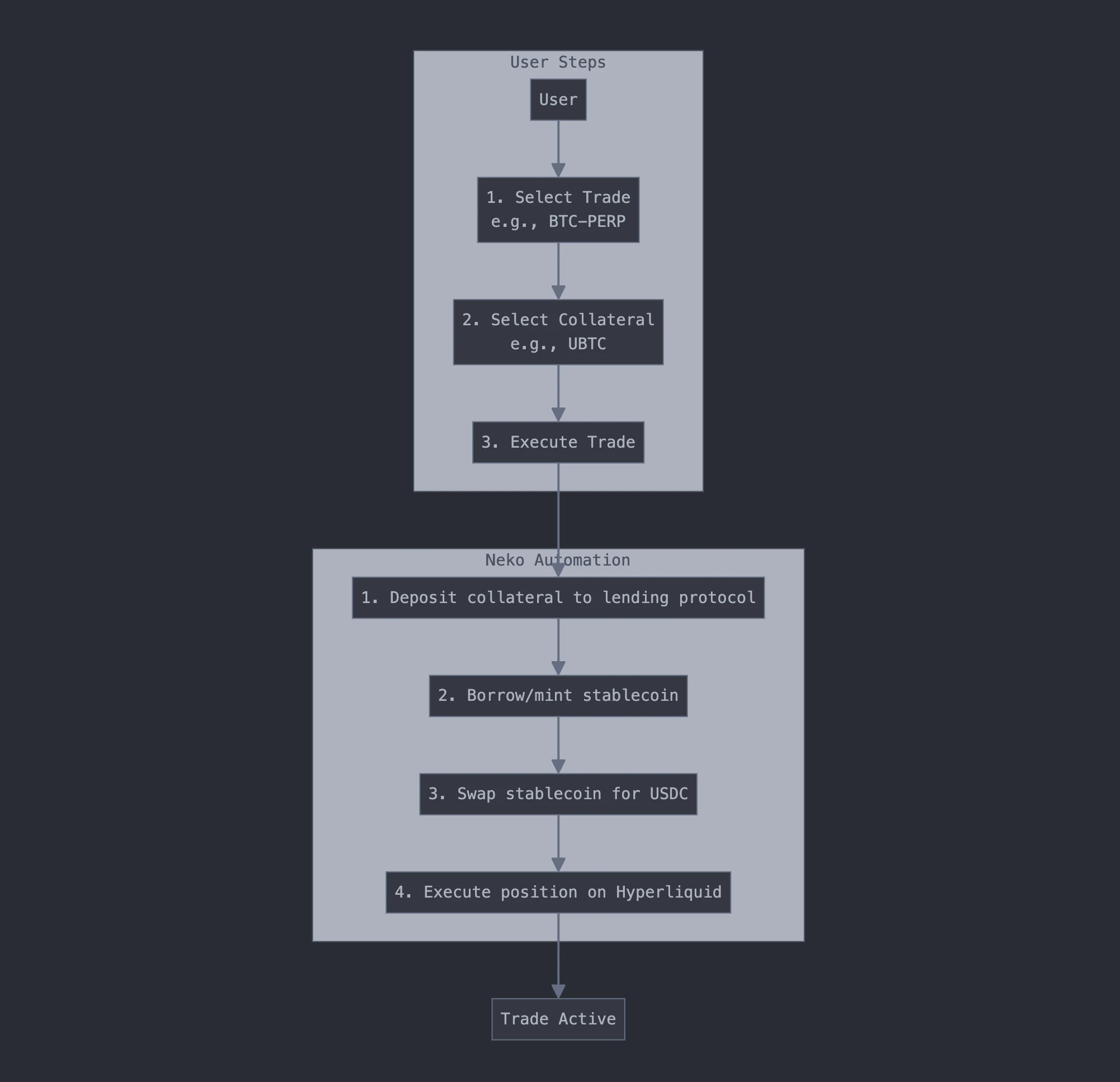
The User Experience: Simple Intent, Powerful Execution
From your perspective, the process is designed for simplicity:- Select Trade: Choose the perpetual contract you wish to trade (e.g., BTC-PERP).
- Select Collateral: Specify the non-USDC asset you want to use as margin (e.g., UBTC).
- Execute: Confirm your trade intent (long or short, size, leverage).
The Neko Automation Engine: How It Works
Behind the scenes, when you initiate a perpetual trade using exotic collateral, dedicated Neko agents orchestrate a multi-step workflow leveraging HyperEVM’s DeFi ecosystem:- Loan Initiation: The Neko agent interacts with integrated HyperEVM lending protocols (such as Felix, HypurrFi, or Hyperlend) to deposit your selected exotic asset (e.g., UBTC) as collateral.
- Optimized Stablecoin Borrowing/Minting: Based on the chosen collateral and available protocols, the agent borrows or mints the required amount of a supported stablecoin:
- Mints feUSD against collateral deposited in Felix.
- Mints USDXL against collateral deposited in HypurrFi.
- Potentially borrows other stablecoins from protocols like Hyperlend. (USDC, USDT, etc.) (Neko aims to optimize this step, considering factors like available liquidity and potentially interest rates across protocols, although specific rate-shopping logic may evolve).
- Stablecoin-to-USDC Swap: The agent takes the borrowed/minted stablecoins (feUSD, USDXL, etc.) and efficiently swaps them for USDC on Hyperliquid (likely utilizing the L1 orderbook or an optimal EVM route). USDC is the required margin currency for Hyperliquid perpetuals.
- Perpetual Position Execution: Finally, the agent uses the acquired USDC as margin to open your desired long or short position on the specified perpetual contract using the Hyperliquid SDK.
Supported Collateral & Lending Protocols
Neko aims to support a growing list of valuable assets held on Hyperliquid as collateral, including but not limited to:- UBTC (via Hyperlend, HypurrFi)
- UETH (via HypurrFi)
- HYPE (via Felix, Hyperlend, HypurrFi)
- wstHYPE (via Hyperlend, HypurrFi)
- (List subject to expansion based on lending protocol support and risk parameters)
Key Considerations: Overcollateralization & Risk
- Overcollateralization: This process relies on overcollateralized borrowing from the underlying lending protocols. This means you must deposit collateral worth more than the value of the stablecoins borrowed (and thus more than the USDC margin ultimately used). The required Loan-to-Value (LTV) ratios vary by asset and lending protocol (e.g., Felix might offer 58.82% LTV for HYPE, while HypurrFi offers 40%). This makes the approach potentially less capital-efficient than using USDC directly, requiring more upfront capital for the same position size.
- Liquidation Risk: Your underlying collateral in the lending protocol is subject to liquidation if its value drops significantly relative to the borrowed stablecoin amount, causing your position’s health factor on the lending platform to fall below the threshold.
- Interest Rates: Borrowing stablecoins (like feUSD or USDXL) incurs interest, which accrues over time on your debt position within the lending protocol.